
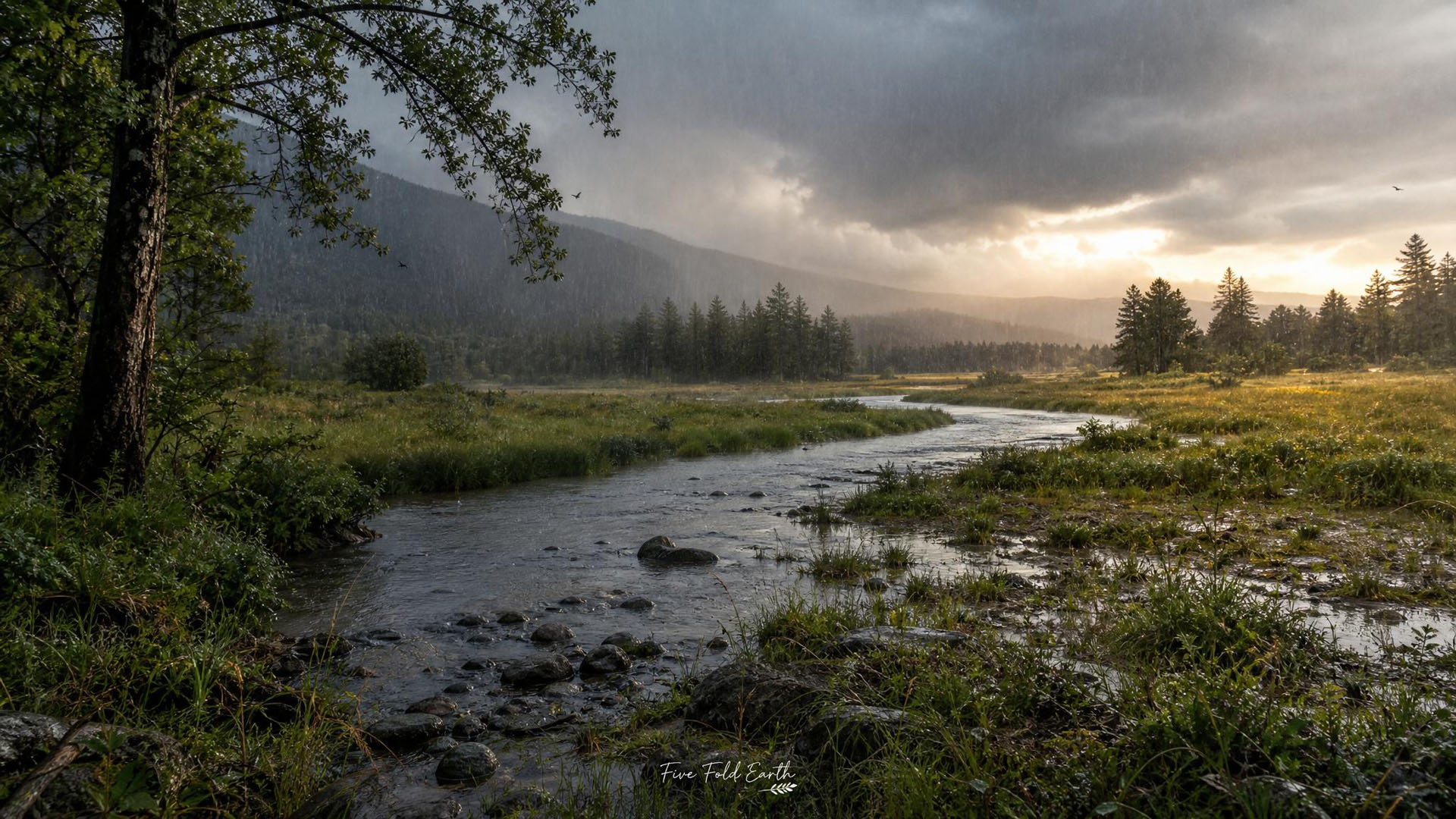
Spiritual Meaning of Rain in Nature Spirituality: Renewal, Blessing, and Release
Rain changes more than landscapes.
It softens hard ground, fills quiet streams, awakens seeds, and leaves the world carrying a different scent than it held only moments before. Familiar places seem transformed beneath a gentle rainfall. Colors deepen, birds grow quieter, and the rhythm of water invites us to notice what we might otherwise hurry past.
For thousands of years, people have looked toward gathering clouds with hope, caution, gratitude, and wonder. Farmers welcomed rain as nourishment for their fields. Travelers searched for shelter. Poets and storytellers returned to it as an image of renewal, longing, blessing, grief, and change.
It is no surprise that many people still wonder about the spiritual meaning of rain. A rainy morning often feels different from a sunny one, not only because the weather has changed, but because our attention changes with it. Rain can quiet a busy street, soften the light, and create room for reflection.
Nature spirituality does not require us to treat every shower as a hidden message. Instead, it invites us to notice the relationship between the living world and our inner lives. Rain becomes meaningful because it reveals patterns we can witness directly: dry ground receives nourishment, water returns to rivers, and landscapes change through steady contact rather than force alone.
Within the Five Elements, Water represents emotion, intuition, adaptability, healing, and flow. Rain is one of its clearest expressions in motion. It connects sky and earth, nourishes forests and gardens, and shows how persistence can reshape even stone.
If you are new to these ideas, begin with our guide to the Water Element in nature spirituality. You may also find our introduction to nature spirituality helpful for understanding the grounded philosophy behind these practices.
Rain asks very little from us except a willingness to pause, listen, and notice what is changing around us and within us.
What Does Rain Symbolize Spiritually?
Rain commonly symbolizes renewal, emotional release, blessing, nourishment, and transformation. In nature spirituality, it can represent movement after stillness and the return of possibility after a dry or difficult season. Its meaning is personal rather than predictive, offering an invitation to reflect, reconnect, and pay closer attention to the natural rhythms shaping both the landscape and your life.
Why Rain Feels Spiritually Significant
There is something about rain that changes the atmosphere before the first drop reaches the ground.
The light softens. Birds alter their songs. Wind carries the scent of damp earth through the trees. People glance toward the sky, quicken their steps, or pause beneath a porch roof to watch the weather unfold. Even indoors, rain against a window can invite a quieter state of mind.
Few natural experiences influence so many senses at once, which may help explain why rain appears so often in stories, poetry, ritual, and spiritual reflection.
Rain Changes How We Experience a Place
Rain transforms an entire environment. Dust disappears from leaves, dry paths darken, shallow pools collect reflections, and forests become richer in color. The scent commonly called petrichor rises as water meets dry ground, making the change feel immediate and unmistakable.
Sound changes too. Falling water softens distant traffic and creates a steady background rhythm. A bird calling between showers or water dripping from a branch becomes easier to notice.
In nature spirituality, this sensory shift can serve as a reminder that transformation does not always arrive dramatically. Rain often works through repetition, creating the conditions in which roots drink, seeds swell, and streams begin moving again.
Rain changes the world one drop at a time. Personal growth often unfolds the same way.

Why the Mind Responds to Rain
The sound of consistent rainfall creates a predictable pattern that many people find soothing. Natural soundscapes can gently hold our attention without demanding the sharp focus required by conversation, alerts, or traffic. A 2024 systematic review and meta-analysis of natural sounds found overall benefits for stress reduction compared with quiet environments, although results varied across the measures studied. Rain may therefore make quiet observation and mindfulness feel more accessible for some people.
Rain also narrows the sensory world in a useful way. Distant views blur, outdoor noise recedes, and attention is drawn toward a smaller field: one window, one roof, one path, one cup warming the hands. That temporary reduction in stimulation can feel like permission to stop scanning for the next demand.
Of course, a reflective mood is not the same as a medical treatment. Rain may support a calming moment, but persistent anxiety, depression, grief, or sleep difficulty deserves appropriate professional care.
Weather also changes the pace of a day. Outdoor plans shift, rooms grow dimmer, and people may spend more time resting, reading, journaling, or simply listening. That slower rhythm can bring emotions and thoughts into focus.
This response is not universal. Rain can feel comforting to one person and isolating, inconvenient, or unsettling to another. Personal memories, climate, safety, and temperament all shape the experience.
The ecological reality is equally meaningful. The U.S. Geological Survey explains the water cycle as the continual movement of water through the atmosphere, land, rivers, oceans, soil, and living systems. Precipitation returns atmospheric water to the surface, where it supports ecosystems and replenishes waterways.
Seen through a spiritual lens, this cycle does not need supernatural explanation to inspire wonder. Rain belongs to a process far larger than any single storm. Water falls, moves through the land, rises again, and returns in another form.
That visible movement gives rain much of its symbolic power. It reminds us that stillness and change are not opposites. A quiet gray day may be carrying water toward roots, rivers, and future growth.

Core Spiritual Meanings of Rain
People have interpreted rain in different ways across cultures and generations, yet several themes return again and again. These meanings are not fixed rules hidden inside the weather. They are patterns people have recognized while living closely with water, land, seasons, and emotion.
Your own understanding of rain may be shaped by memory, climate, loss, celebration, or the season of life you are moving through. The following symbols are best used as invitations to reflection rather than predictions.
Rain as Cleansing and Emotional Release
Perhaps the most familiar rain symbolism is cleansing. Rain washes dust from leaves, clears the air, and refreshes landscapes worn down by heat.
That physical renewal makes rain a natural image for releasing tension, resentment, worry, or emotional exhaustion. It does not literally remove difficult feelings, but it can help us imagine loosening our grip on what has become too heavy to carry unchanged.
Within the Water Element, emotional flow means acknowledging feelings without allowing them to define every moment. Our guide to emotional healing through the Water Element explores that relationship more deeply.
This section contains affiliate links

Water in the Wheel of the Year
Seasonally, Water is present in every turning.
Imbolc’s melting snow
Ostara’s spring rain
Beltane’s morning dew
Mabon’s reflective lakes
Samhain’s drifting mist
Each Sabbat carries Water energy in unique expression.
In Autumn especially, Water supports release. Falling leaves drift into streams, teaching surrender.
In Winter, Water freezes into stillness, showing that rest is also sacred.
Exploring the Wheel of the Year can deepen awareness of how seasonal cycles mirror emotional transformation.
Nature’s waters teach that every ending prepares the ground for renewal.
Signs of Water Element Imbalance
Like all elements, Water can become excessive or depleted.
Excess Water may appear as:
- Overwhelm
- Emotional flooding
- Difficulty setting boundaries
- Mood instability
Depleted Water may appear as:
- Emotional numbness
- Creative block
- Disconnection from intuition
- Dryness in spirit or imagination
Restoring Water balance requires gentle attention, not force.
Ways to rebalance include:
- Drinking water mindfully
- Spending time near natural bodies of water
- Practicing breathwork with focus on fluid rhythm
- Allowing tears without judgment
Water responds to tenderness.
Healing flows where compassion replaces resistance.
Rain as Blessing, Fertility, and Nourishment
For much of human history, rain meant survival. Seasonal rainfall supported crops, replenished water sources, sustained livestock, and nourished wild ecosystems. A dependable rainy season could bring abundance, while drought placed entire communities at risk.
This dependence helps explain the enduring rain blessing meaning. Rain represents what arrives from beyond our direct control yet makes growth possible.
Gardeners still know the feeling. After weeks of dry weather, a steady rainfall can revive tired plants and change the mood of an entire garden. It reminds us that growth depends not only on effort, but also on receiving support, rest, encouragement, and resources.
Rain as Grief, Longing, and Tenderness
Not every rainstorm feels joyful. Gray skies and water running down glass often accompany moments of remembrance, loneliness, or longing in literature, music, and personal memory.
Nature spirituality does not ask us to rush sadness away. Rain can create space to sit with grief without turning it into a problem that must be solved immediately. It may become a quiet companion while journaling, remembering someone, or allowing tears to come.
The symbolism is not that suffering automatically produces something beautiful. It is that tenderness deserves attention, and emotional weather changes when it is allowed room to move.
Rain as Change After Stagnation
Rain alters conditions. The air cools, soil softens, water gathers, and dormant seeds receive what they need to begin.
That makes rain a fitting symbol for periods when life starts moving after feeling stuck. Recovery from burnout, clarity after uncertainty, or the first small step after loss may not look dramatic from the outside. Yet a change in conditions can matter before visible results appear.
Meaningful change is often cumulative. One shower may not refill a river, just as one good day may not complete a healing process. Small shifts still count.
Rain as Interdependence
Rain also symbolizes relationship. A cloud does not keep its water, a river does not create its own source, and a garden cannot flourish through sunlight alone. Each part of the landscape depends upon exchanges that are easy to overlook when conditions are comfortable.
This can become a gentle reminder that self-sufficiency has limits. Receiving help, sharing resources, and caring for the watersheds that sustain a community are not signs of weakness. They are expressions of the same interdependence visible throughout the natural world.
Rain as Hope and New Beginnings
Perhaps the most enduring rain spiritual message is hope, especially when rain arrives after drought, heat, or prolonged waiting.
The first drops do not promise that every hardship will disappear quickly. They simply demonstrate that conditions can change. A landscape that looked exhausted may still contain roots, seeds, and life waiting for water.
Rain rarely asks permission before changing the landscape. Growth often arrives the same way.
Rain can therefore symbolize a beginning that does not erase what came before. The dry season remains part of the story, but it is no longer the only chapter being written.

Rain Across Cultures and Traditions
Rain has shaped ceremony, story, agriculture, and seasonal knowledge across the world. Because communities live in different climates and carry distinct histories, there is no single universal interpretation. Specific examples are more respectful and useful than blending many traditions into one vague idea of “ancient wisdom.”
In a desert region, rain may be remembered as rare relief. In a monsoon climate, it may carry both nourishment and danger. In a farming community, its timing can matter as much as its amount. Geography helps shape symbolism, which is why cultural meanings should always be read in context.
Agricultural Reverence and Rain Ceremonies
Where rainfall determined whether crops succeeded, rain could become both an ecological necessity and a focus of communal ritual.
The Smithsonian’s National Museum of the American Indian catalogs a Nahua jaguar-dancer mask used during a Rain Ceremony in Acatlán, Guerrero, Mexico. Rather than representing all Nahua belief, this specific object shows how rainfall, ceremony, art, and community identity can meet within a particular place and tradition.
Scholars have documented equally varied rain-making traditions elsewhere. A study published through Cambridge University Press describes several regional rain-making ceremonies in Iran, emphasizing that practices changed across place and community.
These examples should not be copied casually as personal rituals. Their value here is historical: they reveal how deeply rain could shape community life when water, harvests, and survival were inseparable.

Rain in Biblical Imagery
In biblical texts, rain appears in several contexts, including provision, judgment, restoration, and covenant. Its meaning changes with the passage rather than remaining uniformly positive or negative.
One clear image appears in Isaiah 55:10–11, where rain and snow water the earth and support seed and food. For a non-religious nature-spirituality reader, this can be appreciated as a historical example of people using rain’s observable effects to express nourishment, purpose, and renewal.
Irish and European Weather Lore
Folk traditions often preserved practical observation alongside superstition. Rain symbolism was therefore not always mystical. Sometimes it was an attempt to read clouds, winds, animals, smoke, and seasonal patterns before scientific forecasting existed.
Ireland’s National Folklore Collection preserves thousands of pages of local weather lore. One record from County Kerry lists observations involving clouds, wind direction, moon halos, and smoke as possible signs of approaching rain. The archived weather-lore account is valuable not because every sign is scientifically reliable, but because it shows how closely people watched the world around them.
This is a more grounded way to approach Celtic and European rain traditions. Rather than claiming one ancient Celtic meaning, we can recognize a long relationship between weather, farming, travel, storytelling, and local memory.
Rain, Water, and Impermanence in Buddhist Reflection
Buddhist traditions do not offer one fixed doctrine about the spiritual meaning of rain. However, early Buddhist texts frequently use water, bubbles, rivers, and changing conditions as images of impermanence.
In the Arising discourse preserved by SuttaCentral, conditioned things are described as impermanent. Rain can be contemplated within that broader teaching because it is visibly temporary: clouds gather, water falls, puddles form, and the landscape changes again.
For a nature-spirituality practice, the lesson is not that Buddhism assigns rain a secret message. It is that changing weather can help us observe a truth shared by many contemplative traditions: no feeling, season, or condition remains exactly as it is.
Holding Cultural Meanings With Respect
Rain has been understood through sacred texts, ceremonies, weather lore, agriculture, and personal reflection. These perspectives sometimes overlap, but they are not interchangeable.
A respectful approach names the tradition, avoids claiming universality, and resists borrowing ceremonies stripped of their community and history. We can learn from the many ways people have honored rain while allowing our own practice to remain simple: attention, gratitude, ecological care, and humility.
From these broader cultural perspectives, we can return to the quieter question of how rain may take on meaning within our own milestones and memories.

Rain on a Wedding Day
Rain on a wedding day is commonly associated with blessing, fertility, unity, and resilience. In farming communities, rain nourished the land and made future abundance possible, so its arrival during a marriage could be interpreted as a hopeful sign for the life being planted together.
A rainy wedding also asks two people to release the day they imagined and meet the day that arrived. Plans shift, umbrellas appear, and laughter often replaces perfection. In that sense, rain can symbolize the adaptability every lasting partnership eventually requires.
It is best understood as a personal symbol rather than a promise of good fortune. The marriage is shaped by the people within it, not by the forecast.
Rain During a Funeral or After Someone Dies
Rain during a funeral may feel like shared mourning. Water gathers on flowers and coats, and the natural world seems to echo the tenderness of the moment.
Some people experience it as cleansing, release, or the beginning of a new relationship with memory. Others find comfort in weather that does not ask them to appear cheerful while grieving.
There is no single spiritual meaning of rain after someone dies. It does not prove that a loved one is sending a message, but it may become part of the day’s story, offering an image for tears, love, transition, and remembrance.

What Does Rain Mean During Important Life Events?
Rain often feels especially meaningful when it arrives during a wedding, funeral, birthday, move, graduation, or another turning point.
These moments already carry emotional weight. When the weather shifts around them, it can feel as though the landscape is participating in the transition. That does not mean rain predicts what happens next. Its meaning comes from the way it mirrors change, release, uncertainty, and beginning again.
Rain on Your Birthday or During a New Beginning
A birthday, move, graduation, or new job already marks a threshold. Rain can deepen that reflective mood and symbolize renewal, emotional clearing, or nourishment for what comes next.
Rather than asking, “Is this a sign?” try asking, “What is this weather helping me notice?” Perhaps a neglected dream needs attention, your body needs rest, or a new chapter needs patience before it begins to feel familiar.
Rain During a Move, Graduation, or Career Change
Transitions that look exciting from the outside can still carry uncertainty. Rain during a move, graduation, retirement, or career change may symbolize the emotional complexity of leaving one identity before the next feels settled.
It can also offer a practical lesson in flexibility. Boxes get covered, ceremonies move indoors, and timelines adjust. The day may not unfold exactly as planned, yet the transition still belongs to you. Rain does not diminish the milestone. Sometimes it makes the threshold more memorable.
Different Types of Rain and Their Symbolism
Not every rainfall creates the same atmosphere. A fine mist feels different from a summer downpour, and those differences can shape the symbolism we find within them.
A Simple Rain Symbolism Guide
- Gentle rain: patience, peace, and gradual healing
- Heavy rain: release, intensity, and rapid change
- Summer rain: vitality, abundance, and renewed energy
- First rain after drought: hope, relief, and new beginnings
- Rain with sunshine: balance, complexity, and unexpected beauty
- Mist or drizzle: mystery, intuition, and moving slowly
Gentle Rain
Gentle rain often symbolizes patience. It nourishes through quiet repetition and can represent healing that happens in small increments rather than through one dramatic breakthrough.
Heavy Rain and Downpours
Heavy rain may symbolize emotional release, cleansing, or accelerated change. Its force can feel liberating, but it also reminds us that intensity requires shelter and discernment.
Not every storm is an invitation to stand outside. Sometimes the wisest spiritual response is to respect nature’s power and watch from safety.
Summer Rain
Summer rain can symbolize replenishment in the middle of growth: the rest, encouragement, or nourishment that allows us to continue without burning ourselves dry.

The First Rain After Drought
Few forms of rain carry more visible hope than the first rain after drought. The scent of soil changes, leaves lift, and water begins gathering where the land has remained empty.
First rain symbolism often centers on relief, renewal, and possibility. It reminds us that a season can appear lifeless while roots are still waiting beneath the surface.
Rain and Sunshine Together
Rain falling through sunlight can symbolize the coexistence of opposite emotions. Gratitude can live beside grief. Hope can appear before fear has disappeared. A new beginning can be beautiful and difficult at once.
Mist and Drizzle
Mist softens edges and limits how far we can see. It often symbolizes intuition, mystery, and the willingness to move without having the entire path revealed.
How to Work With Rain in Nature Spirituality
You do not need an elaborate ceremony to connect with rain. The most meaningful practices often begin with attention.
A Five-Minute Rain-Listening Meditation
- Sit near a covered window, doorway, or porch where you can hear the rain safely.
- Take three comfortable breaths and let your shoulders soften.
- Notice the nearest sound of water, then the farthest sound you can hear.
- Observe the rhythm without trying to label every sound.
- Ask, “What am I ready to let move?”
- End by naming one thing the rain is nourishing.
If quiet attention is new to you, this guide to beginning a simple meditation practice offers a gentle foundation.
A Walking Meditation in Gentle Rain
The walking in the rain spiritual meaning often comes from direct participation. You feel cool air, softened light, and droplets gathering on leaves and clothing.
Choose a familiar route during light rain. Wear suitable shoes and avoid flooded paths, fast-moving water, exposed high ground, and slippery terrain.
If you hear thunder, go indoors immediately. The National Weather Service advises seeking shelter as soon as thunder is heard. Review its lightning safety guidance before planning an outdoor rain practice.

A Simple Rainwater Gratitude Ritual
Place a clean bowl outside during gentle rain, away from roof runoff. Bring it inside and pause to notice the water before using it.
You might say:
May I remember that every living thing depends upon receiving. May I offer gratitude for what nourishes life.
Use the water for an ornamental outdoor plant, an outdoor ritual object, or return it to the earth. For another symbolic water practice, explore these mindful moon water rituals.
Journal With the Weather
- What in my life is ready to soften?
- What have I been carrying past its season?
- Where do I need nourishment rather than more effort?
- What is beginning beneath the surface?
These journaling practices for mental clarity can help you continue the reflection without forcing an immediate answer.
Rainwater Safety
Collected rainwater is not automatically safe to drink, cook with, brush your teeth with, or apply to the body. It can pick up germs, chemicals, dust, smoke, roofing residue, animal waste, and other contaminants.
The Centers for Disease Control and Prevention recommends treated tap or bottled water for drinking and food-related uses whenever possible. Its rainwater collection safety guidance also advises testing, treatment, and proper system maintenance for broader uses.
For a personal ritual, symbolic use is enough. You do not need to drink rainwater to honor it.
What Rain Can and Cannot Mean
Rain can become a meaningful symbol of cleansing, blessing, grief, nourishment, hope, or change. It can help you name an emotion, remember a loved one, or recognize a transition already unfolding.
Rain cannot reliably predict the future. It is not proof that a relationship will succeed, that a deceased loved one is sending a message, or that every difficult event has a hidden purpose.
A grounded nature-spirituality practice leaves room for meaning without demanding certainty. You can cherish the rain that fell on an important day while also understanding it as weather.

Frequently Asked Questions About the Spiritual Meaning of Rain
Does Rain Symbolize Good Luck?
Rain is associated with good fortune in many traditions because it nourishes crops, replenishes water sources, and supports abundance. It can be embraced as a hopeful symbol, but it does not guarantee a particular outcome.
Is Rain a Blessing?
Rain can be understood as a blessing because life depends upon it. The rain blessing meaning often reflects gratitude for nourishment, relief after dryness, and resources that arrive beyond our control.
Why Do I Feel Peaceful When It Rains?
The steady sound, softened light, cooler air, and slower pace of rainy weather can feel restful. Personal memories and preferences also shape whether rain feels peaceful or uncomfortable.
What Does Rain Symbolize in Dreams?
Dream symbolism is personal. Rain might reflect emotion, release, sadness, renewal, or recent experiences with weather. Consider how the rain felt and what was happening rather than relying on a fixed dictionary meaning.
What Does Rain Mean Spiritually After Someone Dies?
Some people interpret rain after a death as shared mourning, cleansing, transition, or continued connection. It can be comforting without serving as objective proof of a message from the deceased.
Is Walking in the Rain Spiritual?
It can be. Walking mindfully in safe, gentle rain can deepen sensory awareness and create a feeling of participation in the Water Element. The spirituality comes from attention and intention, not from taking weather risks.
Can Rain Be Used for Meditation?
Yes. A listening to rain meditation can use its natural rhythm as a focus for breathing, emotional observation, or quiet reflection.
Why Does Rain Feel Healing?
Rain visibly refreshes the land and can create a quieter sensory environment. That may mirror emotional release and make reflection easier, but it is not a substitute for healthcare or mental health treatment.

The Quiet Wisdom of Rain
Rain asks nothing from us except our willingness to notice it.
Sometimes it waters forests and gardens. Sometimes it fills rivers, cools summer streets, or gathers in shining beads along a leaf.
Sometimes it simply reminds us to slow down long enough to hear ourselves think.
The spiritual meaning of rain is not found in treating every storm as a prediction. It is found in paying attention to what rain has always shown us: life depends upon movement, growth requires nourishment, and no season remains unchanged forever.
Rain does not promise that every season will be easy. It reminds us that even the driest ground can receive water again.
The next time rain begins, pause before calling it inconvenient.
Listen to the roof, the leaves, or the glass.
Notice what softens.
Notice what moves.
Then ask what within you may also be ready to receive, release, or begin again.
If rain deepens your connection to Water, you may also enjoy exploring a daily spiritual shower ritual or a more immersive ritual bath for reflection and renewal.


