
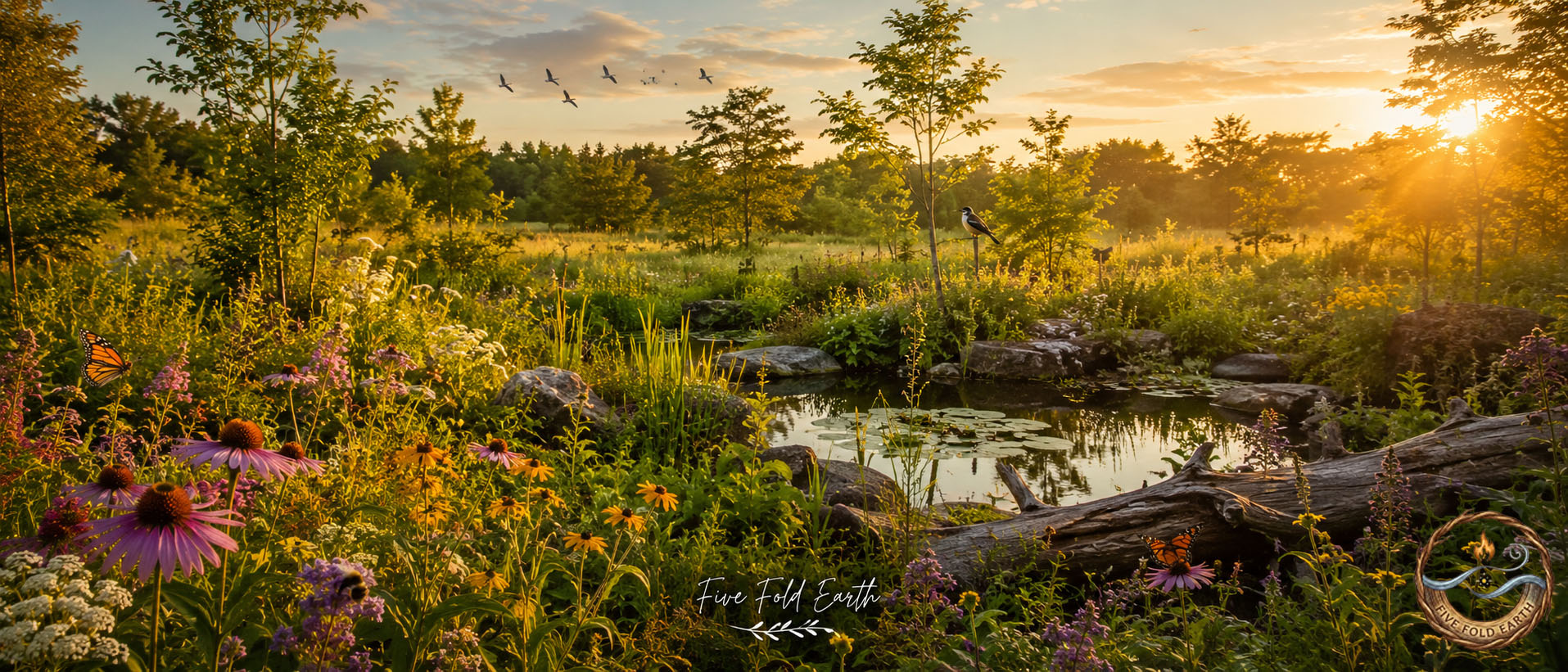
Sacred Rewilding: How to Restore Land, Support Wildlife, and Deepen Your Connection to Nature
Sacred rewilding is about more than restoring habitat. It is about remembering our place within the living world.
Many of us spend our days surrounded by schedules, screens, pavement, and constant noise. The natural rhythms that once guided human life can feel distant. Yet beneath the surface, there remains a quiet longing to reconnect with something older and deeper.
Perhaps you’ve felt it while watching a butterfly move through a patch of wildflowers. Maybe it appeared during an early morning walk when birdsong filled the air before the world fully woke. Sometimes it arrives while kneeling in the garden, hands pressed into warm soil.
These moments remind us that we are not separate from nature. We are participants in it.
Sacred rewilding offers a way to nurture that relationship while creating tangible benefits for the land itself. By supporting wildlife, restoring biodiversity, and embracing more natural landscapes, we help create healthier ecosystems while often discovering a greater sense of peace and belonging.
Whether you steward several acres, tend a suburban backyard, or care for a few containers on a balcony, rewilding begins with a simple shift in perspective: seeing the land not as something to control, but as something to collaborate with.
At Five Fold Earth, we often explore how personal wellness and nature connection intertwine. In many ways, sacred rewilding is an extension of the principles explored in our guide to bringing more wildness back into everyday living. Both invite us to slow down, observe, and cultivate a deeper relationship with the world around us.

What Is Sacred Rewilding?
Traditional rewilding focuses on restoring ecosystems and allowing natural processes to return. Conservation organizations often use the term when discussing habitat restoration, wildlife corridors, native species recovery, and ecological resilience.
Sacred rewilding includes these practical goals while adding another layer: relationship.
It recognizes that restoring land can also restore something within ourselves.
When we create habitat for birds, pollinators, frogs, beneficial insects, and native plants, we participate in a reciprocal exchange. The land becomes healthier, and we often feel healthier too.
In this way, sacred rewilding sits at the intersection of:
- Wildlife habitat restoration
- Regenerative gardening
- Environmental stewardship
- Nature spirituality
- Personal well-being
- Seasonal living
The approach is intentionally inclusive. It does not require any particular spiritual belief system. Instead, it invites curiosity, observation, gratitude, and a willingness to engage more deeply with the living world.
Sacred rewilding begins the moment we stop asking how the land can serve us and start asking how we can become better partners with the land.
For some people, this may look like replacing part of a lawn with native flowers. For others, it may mean planting trees, restoring soil, building wildlife habitat, or simply paying closer attention to seasonal changes.
What matters most is not the size of the project. What matters is the relationship being cultivated along the way.
This perspective aligns closely with the principles explored in our discussion of gardening as a mindful and meaningful practice, where the act of tending the earth becomes an opportunity for reflection and connection.
Sacred Rewilding at a Glance
- Supports wildlife and biodiversity
- Improves soil and ecosystem health
- Encourages regenerative gardening practices
- Strengthens personal connection with nature
- Can be practiced on any property size
- Works alongside food production and homesteading
- Invites seasonal awareness and mindfulness

Why Rewilding Matters More Than Ever
Across much of the world, natural habitats have become increasingly fragmented.
Lawns replace meadows. Parking lots replace wetlands. Development often removes the diverse plant communities that once supported birds, pollinators, insects, and countless other forms of life.
While large-scale conservation efforts remain essential, small actions on private land can collectively make a meaningful difference.
A patch of native flowers can feed migrating butterflies.
A brush pile can shelter birds and beneficial insects.
A wildlife pond can support frogs, dragonflies, and pollinators.
Every habitat patch contributes to a larger ecological network.
Research also continues to demonstrate the benefits of spending time in nature. According to the Harvard Health Publishing review on nature exposure and well-being, regular contact with natural environments may help support stress reduction, mood, and overall mental wellness.
This connection between ecological health and personal well-being is one reason sacred rewilding feels especially relevant today.
As we create space for wildlife, we often create space for ourselves as well.
Birdsong returns.
Pollinators return.
Quiet returns.
Many people discover that the process of restoring habitat naturally encourages a slower pace of life. It invites observation instead of constant activity. Rather than trying to dominate nature, we begin learning from it.
Within the Five Fold Earth framework, this process reflects the wisdom of the Earth Element, which teaches stability, nourishment, patience, and growth.
At the same time, rewilding touches every element:
- Earth through soil regeneration and plant life
- Water through ponds, rain gardens, and watershed health
- Air through pollinators, birds, and living ecosystems
- Fire through sunlight, energy, and natural cycles of renewal
- Spirit through connection, meaning, and belonging
When viewed through this lens, sacred rewilding becomes more than a gardening project.
It becomes a way of participating in the healing and renewal of both land and self.
Every patch of restored habitat is an act of hope. Every native flower planted is a vote for a more vibrant future.
In the next section, we’ll explore how the Five Elements offer a unique framework for understanding sacred rewilding and creating landscapes that support both ecological health and personal connection to the natural world.

The Five Elements of Sacred Rewilding
One of the beautiful things about sacred rewilding is that it can be understood through many different lenses.
Some people see it through ecology and conservation. Others approach it through gardening, homesteading, or environmental stewardship.
At Five Fold Earth, I often return to the Five Elements because they offer a simple and meaningful way to understand our relationship with the natural world.
The elements are not separate forces existing apart from one another. They work together continuously, shaping landscapes, ecosystems, seasons, and our own experiences of life.
When we engage in sacred rewilding, we are supporting the health and balance of all five.
If you’re new to this perspective, you may enjoy exploring the foundations of the Five Elements framework as a companion to this journey.
Let’s look at how each element expresses itself within the practice of sacred rewilding.

Earth: Restoring the Living Foundation
Every rewilding effort begins with Earth.
Beneath every meadow, forest edge, pond, and pollinator garden lies an entire world that most of us rarely see.
Healthy soil is alive.
It contains fungi, microbes, insects, earthworms, roots, organic matter, and countless relationships working together below the surface.
Modern landscaping practices often disturb these systems through excessive tilling, synthetic chemicals, and the removal of natural plant diversity.
Sacred rewilding seeks to reverse that pattern.
Instead of forcing the land into rigid control, we begin supporting the natural processes that build fertility and resilience over time.

This may include:
- Planting native species
- Adding organic matter to the soil
- Reducing disturbance
- Leaving some areas wild
- Supporting fungal networks and beneficial organisms
- Creating habitat for insects and decomposers
Even small changes can have a profound impact.
A fallen branch left to slowly decompose may feed hundreds of organisms. A patch of native flowers can support pollinators while also enriching soil life through their root systems.
As discussed in our guide to building healthy soil naturally, the most fertile landscapes are often those where nature is allowed to participate more fully in the process.
When we restore the soil, we are not simply growing plants. We are rebuilding an entire community beneath our feet.
The Earth element reminds us that meaningful growth often begins below the surface, quietly and patiently, long before visible results appear.

Water: Supporting Life Through Flow and Renewal
Water is often the element that determines whether a landscape thrives or struggles.
Healthy ecosystems know how to capture, store, filter, and slowly release water.
Many conventional landscapes do the opposite.
Compacted lawns, bare soil, and excessive runoff can prevent water from soaking into the ground where it is needed most.
Rewilding helps restore natural water cycles.
Native plants often develop deep root systems that improve infiltration and help stabilize soil. Trees create shade that reduces evaporation. Ground covers protect moisture while supporting beneficial organisms.
Even simple projects can strengthen the Water element:
- Rain gardens
- Wildlife ponds
- Native wetland plants
- Mulching and soil building
- Reducing runoff
- Collecting rainwater where permitted
Water also teaches an important emotional lesson.
It reminds us that resilience is not rigidity. It is adaptability.
Just as rivers find their way around obstacles, we too can learn to move through life’s changing seasons with greater grace.
This relationship between water and emotional well-being is explored more deeply in our article on the healing wisdom of the Water Element.
In sacred rewilding, every effort to protect water ultimately supports life itself.

Air: Creating Space for Movement and Biodiversity
The Air element is present in every breeze that carries seeds across a meadow and every wingbeat of a migrating bird.
It is movement, connection, communication, and exchange.
Many wildlife species depend upon connected habitats in order to survive. Birds travel between nesting sites and feeding areas. Pollinators move from flower to flower. Seeds disperse across the landscape.
When natural spaces become fragmented, these relationships become more difficult.
Sacred rewilding helps rebuild those connections.
Pollinator gardens, wildlife corridors, native hedgerows, flowering meadows, and layered habitats all contribute to healthier ecological networks.
Air invites us to think beyond the boundaries of our own property.
A single garden may seem small, but when connected to neighboring habitats, it becomes part of something much larger.
Much like the practices explored in our exploration of the Air Element, rewilding encourages openness, perspective, and connection.
Simple Ways to Support the Air Element
- Plant flowers for pollinators
- Create habitat for birds
- Allow seed heads to remain through winter
- Reduce pesticide use
- Support wildlife corridors
- Plant native trees and shrubs
Sometimes the smallest patch of habitat becomes an important resting place in a much larger journey.

Fire: Embracing Energy, Growth, and Transformation
Fire is often misunderstood within nature-centered practices.
Many people associate it only with destruction, yet Fire is equally connected to transformation, vitality, and renewal.
Without sunlight, there would be no photosynthesis, no plant growth, and no thriving ecosystems.
The warmth of the sun powers every landscape we seek to restore.
In sacred rewilding, Fire appears through:
- Solar energy
- Plant growth
- Seasonal cycles
- Seed germination
- Ecological succession
- The courage to create change
Rewilding often asks us to challenge conventional ideas about what a landscape should look like.
Allowing areas to become more natural can feel uncomfortable at first, especially when tidy lawns and manicured spaces are considered the norm.
Fire gives us the confidence to try something different.
It encourages us to become active participants in ecological renewal.
This transformative energy echoes many of the themes explored in working with the motivational qualities of Fire.
Every native seed planted is an act of optimism. Every restored habitat begins with the willingness to imagine a different future.

Spirit: Remembering Our Place Within the Living World
While Earth, Water, Air, and Fire can be observed directly in the landscape, Spirit emerges through relationship.
It is the sense of belonging many people feel when standing beneath old trees, listening to birds at dawn, or watching sunlight move across a meadow.
Spirit reminds us that we are not separate observers of nature.
We are participants.
This understanding sits at the heart of sacred rewilding.
The goal is not simply to increase biodiversity, though that is important. The goal is also to restore connection.
Connection between people and place.
Connection between wildlife and habitat.
Connection between daily life and seasonal rhythms.
As explored in our beginner’s guide to nature spirituality, meaningful connection does not require complicated rituals or specific beliefs.
Often, it begins with paying attention.
Watching the first butterfly of spring.
Noticing which birds visit the garden.
Learning the names of native plants.
Observing how the landscape changes throughout the year.
These simple acts of awareness can gradually transform the way we relate to the natural world.
Spirit is not something we add to a landscape.
It is something we notice when we become fully present within it.

Bringing the Elements Together
In reality, the Five Elements never operate in isolation.
Healthy soil supports plants. Plants slow water runoff. Water nourishes wildlife. Pollinators move through the air. Sunlight fuels growth. Through it all, our awareness deepens.
Sacred rewilding invites us to see these relationships more clearly.
The result is not merely a more beautiful landscape.
It is a living ecosystem that supports wildlife, strengthens ecological resilience, and offers countless opportunities to reconnect with the rhythms of the natural world.
Next, we’ll explore the practical side of sacred rewilding and how restoring habitat can help support biodiversity, pollinators, birds, and wildlife on properties of every size.

Rewilding Land for Wildlife Habitat Restoration
When many people hear the word rewilding, they imagine vast landscapes filled with roaming wildlife, restored forests, and protected natural areas.
While large-scale conservation efforts are incredibly important, wildlife habitat restoration can begin much closer to home.
A backyard garden.
A neglected corner of a property.
A hedgerow along a fence line.
A patch of native wildflowers.
Even the smallest spaces can become part of a larger ecological story.
At its heart, sacred rewilding is about creating opportunities for life to return. It is an invitation to support the countless species that share our landscapes while developing a deeper relationship with the places we call home.
Rather than viewing land as something that must always be controlled, rewilding encourages us to ask a different question:
What would happen if we allowed nature a little more room to participate?
Often, the answer is remarkable.


Why Wildlife Habitat Matters
Healthy ecosystems depend upon diversity.
Birds, pollinators, insects, amphibians, mammals, fungi, and plants all play important roles in maintaining ecological balance. Each species contributes to a web of relationships that supports the health of the whole system.
When habitat disappears, those relationships become strained.
Pollinators may struggle to find food sources.
Birds may lose nesting sites.
Beneficial insects may have fewer places to shelter and reproduce.
Over time, biodiversity declines and ecosystems become less resilient.
Wildlife habitat restoration seeks to reverse this trend by providing food, water, shelter, and safe places for species to complete their natural life cycles.
The encouraging news is that meaningful habitat restoration does not require hundreds of acres. Small actions, repeated across neighborhoods and communities, can collectively create significant ecological benefits.
A single flowering plant may feed dozens of pollinators.
A native shrub may provide nesting habitat for birds.
A small pond may support frogs, dragonflies, and beneficial insects.
Together, these seemingly simple changes help strengthen the larger landscape.
The Four Foundations of Wildlife Habitat
Most successful wildlife habitats share four basic elements.
Whether you are rewilding a homestead, suburban yard, or container garden, these principles remain surprisingly consistent.
The Foundations of Habitat Restoration
- Food through native plants, flowers, seeds, berries, and natural forage.
- Water through ponds, bird baths, rain gardens, and healthy soil moisture.
- Shelter through trees, shrubs, grasses, brush piles, and natural cover.
- Space that allows wildlife to move, nest, feed, and reproduce safely.
Many conventional landscapes provide very few of these elements. Large areas of lawn may look neat and orderly, but they often offer limited value to wildlife.
By contrast, diverse landscapes tend to support a much wider range of species.
This does not mean every property must become completely wild.
Sacred rewilding is rarely an all-or-nothing approach. More often, it involves thoughtfully blending human needs with ecological function.
A productive vegetable garden can exist alongside pollinator habitat.
A maintained pathway can wind through native plantings.
A carefully tended yard can still provide refuge for wildlife.
The goal is balance rather than abandonment.
Seeing the Landscape as a Living Community
One of the most transformative shifts in sacred rewilding is learning to see the landscape differently.
Instead of focusing only on individual plants, we begin noticing relationships.
We see bees moving between flowers.
Birds gathering nesting materials.
Butterflies searching for host plants.
Earthworms improving soil structure beneath the surface.
Each organism becomes part of a larger story.
This perspective often develops naturally through observation.
Many people find that spending more time outdoors deepens both ecological awareness and personal well-being. If you’ve explored our article on finding wisdom through nature’s rhythms, you’ll recognize this same invitation to slow down and pay attention.
The more we observe, the more interconnected the landscape begins to appear.
A garden is no longer simply a collection of plants.
It becomes a living community.
A place where countless forms of life interact, adapt, and support one another.
Small Spaces Can Make a Big Difference
One of the most common misconceptions about wildlife habitat restoration is that it requires a large property.
In reality, every patch of habitat contributes to a larger ecological network.
Pollinators do not recognize property lines. Birds move freely between neighborhoods. Seeds travel on the wind. Wildlife often depends upon many small habitat patches working together across a landscape.
This means that even people living in apartments, townhomes, or urban environments can participate in sacred rewilding.
A container of native flowers can provide nectar. A small water source can support beneficial insects. A balcony garden may become a valuable resting place for pollinators moving through the city.
The scale may differ, but the intention remains the same.
Every act of restoration contributes to a healthier and more connected ecosystem.
Wildlife Habitat Restoration as an Act of Reciprocity
Many nature-centered traditions speak of reciprocity, the idea that healthy relationships involve both receiving and giving.
For generations, people have drawn food, beauty, resources, and inspiration from the natural world.
Wildlife habitat restoration offers an opportunity to give something back.
Not through grand gestures, but through consistent and thoughtful actions.
Planting native flowers.
Leaving a corner of the yard wild.
Protecting soil health.
Providing water during dry seasons.
Creating space for life to flourish.
These choices may seem small, yet they ripple outward in ways we may never fully see.
In many ways, habitat restoration reflects the same mindful relationship with nature explored in simple grounding practices inspired by the Earth element. Both invite us to move from ownership toward partnership.
Rather than asking what we can take from the land, sacred rewilding encourages us to consider what we can contribute.
That shift in perspective may be one of the most meaningful forms of restoration of all.
Wildlife habitat restoration is only one piece of the sacred rewilding puzzle. Equally important is the health of the soil itself. In the next section, we’ll explore how regenerative gardening practices can help rebuild living soil, strengthen ecosystems, and support abundance for both people and wildlife.

Regenerative Gardening and the Return of Living Soil
When most people think about gardening, their attention naturally goes to what grows above the ground.
Flowers blooming in summer.
Vegetables ripening on the vine.
Butterflies visiting pollinator plants.
Trees stretching toward the sky.
Yet one of the most important parts of any thriving landscape remains largely invisible.
It lies beneath our feet.
Healthy soil is not simply dirt. It is a living ecosystem filled with microorganisms, fungi, insects, roots, organic matter, and countless interactions that support life above ground.
In many ways, the success of sacred rewilding begins here.
Before birds return. Before pollinators arrive. Before native plants establish themselves. The soil must provide a foundation capable of supporting those relationships.
This is where regenerative gardening becomes such an important part of wildlife habitat restoration.
What Is Regenerative Gardening?
Regenerative gardening is an approach that seeks to improve the health of the land rather than simply maintain it.
Instead of viewing soil as a growing medium that requires constant inputs, regenerative practices work with natural processes to build fertility, biodiversity, and resilience over time.
The goal is not only to grow healthy plants but to create healthier ecosystems.
Many regenerative gardening techniques mirror the way natural landscapes function without human intervention.
Leaves fall and decompose.
Roots feed soil organisms.
Organic matter accumulates.
Water is absorbed and retained.
Nutrients are continually recycled.
Nature has been building healthy soil for millions of years. Regenerative gardening simply seeks to cooperate with those processes rather than disrupt them.
If you’re interested in exploring this relationship more deeply, our article on the wellness benefits of gardening highlights how caring for living systems often supports our own well-being as well.
Why Living Soil Matters for Wildlife
When discussing wildlife habitat restoration, it can be easy to focus on visible species such as birds, butterflies, bees, and native plants.
However, every thriving ecosystem depends upon a vast community of life beneath the surface.
Soil organisms help:
- Break down organic matter
- Recycle nutrients
- Improve soil structure
- Increase water retention
- Support plant health
- Strengthen ecosystem resilience
Healthy soil creates healthier plants.
Healthier plants support more insects.
More insects support birds, amphibians, and other wildlife.
The entire system is connected.
When viewed through the lens of sacred rewilding, soil is not merely the foundation of a garden. It is one of the largest and most diverse habitats on the property.
Protecting that hidden ecosystem often produces benefits that ripple throughout the landscape.
A thriving landscape begins long before the first flower blooms. It begins in the unseen relationships beneath the soil.
Working With Nature Instead of Against It
One of the guiding principles of sacred rewilding is partnership.
Rather than attempting to control every aspect of the landscape, regenerative gardening encourages observation and collaboration.
This shift can feel surprisingly freeing.
Instead of constantly fighting natural processes, we begin asking how those processes can help us create healthier and more resilient spaces.
For example:
- Fallen leaves become mulch instead of waste.
- Plant diversity improves ecosystem health.
- Deep-rooted plants help loosen and enrich soil.
- Organic matter becomes a resource rather than something to remove.
- Beneficial insects contribute to natural balance.
These practices often result in landscapes that require fewer external inputs while becoming increasingly productive over time.
This is one reason regenerative gardening has become so popular among gardeners, homesteaders, and conservation-minded land stewards alike.
It supports both human needs and ecological health.
The Return of Biodiversity
As soil health improves, biodiversity often follows.
Native plants establish more successfully.
Pollinators discover new food sources.
Birds find insects and seeds.
Beneficial organisms return to the soil.
Over time, the landscape becomes more dynamic and self-supporting.
This process rarely happens overnight.
One of the greatest lessons regenerative gardening teaches is patience.
Nature tends to work gradually.
Healthy ecosystems are built through countless small interactions unfolding over seasons and years.
This slower pace mirrors many of the themes explored in living in rhythm with the natural seasons, where growth is understood as a cyclical process rather than a constant push toward immediate results.
Each season contributes something valuable.
Each stage of restoration has its purpose.
And every small improvement creates opportunities for additional life to return.

Regenerative Gardening as a Relationship
Perhaps the most meaningful aspect of regenerative gardening is that it changes the way we see the land.
We begin noticing connections that may have previously gone unnoticed.
A layer of leaves becomes future soil.
A flowering plant becomes food for pollinators.
A healthy soil ecosystem becomes habitat for countless organisms.
The garden is no longer a collection of individual plants.
It becomes a living network of relationships.
For many people, this awareness naturally deepens their sense of connection to place.
It transforms gardening from a task into a conversation.
One rooted in observation, reciprocity, and respect.
This perspective reflects many of the principles discussed in creating a living relationship with the plants we grow, where tending the garden becomes part of a larger practice of mindful stewardship.
Small Steps Toward Living Soil
The encouraging reality is that regenerative gardening does not require perfection.
Every landscape exists somewhere along a continuum of restoration, and even small choices can help support the return of living soil.
- Adding organic matter
- Planting diverse species
- Reducing unnecessary soil disturbance
- Supporting pollinators and beneficial insects
- Protecting soil from erosion and compaction
These actions may seem simple, yet they contribute to healthier ecosystems, stronger plant communities, and more resilient landscapes.
Most importantly, they help restore the living foundation upon which all other forms of rewilding depend.
As we continue exploring sacred rewilding, the next question becomes practical: what does this look like on different types of properties?

Sacred Rewilding for Homesteads and Large Properties
For those fortunate enough to steward several acres, a homestead, or larger rural property, sacred rewilding offers a unique opportunity to create meaningful ecological impact.
Large properties often contain untapped potential.
A neglected fence line may become a wildlife corridor.
An underused field may support pollinators and native grasses.
A seasonal low spot may provide habitat for amphibians and beneficial insects.
Even small changes across larger landscapes can create significant benefits for wildlife.
One of the most common misconceptions about rewilding is that it requires giving up productive land. In reality, many landowners discover the opposite is true.
Healthy ecosystems often support healthy homesteads.
Pollinators improve harvests.
Beneficial insects assist with natural pest management.
Healthy soil supports stronger plant growth.
Diverse landscapes often become more resilient during periods of drought, extreme weather, and environmental stress.
Sacred rewilding encourages landowners to look beyond individual garden beds and begin seeing the entire property as an interconnected ecosystem.
Wooded areas, ponds, meadows, hedgerows, food gardens, orchards, and pastureland all contribute to the larger ecological picture.
Rather than separating productive spaces from natural spaces, rewilding seeks to create a partnership between the two.
Potential Rewilding Opportunities on Larger Properties
- Native hedgerows and shelterbelts
- Pollinator meadows
- Wildlife ponds
- Forest edge habitat
- Brush piles and deadwood habitat
- Native tree planting
- Wildlife corridors connecting habitat areas
Many of these opportunities will be explored in greater depth throughout our Sacred Rewilding article series. For now, it is enough to recognize that larger properties can become powerful places of restoration when managed with both ecological health and long-term stewardship in mind.
At its best, sacred rewilding transforms a homestead from a collection of projects into a living landscape that supports both human needs and the needs of countless other species.
A thriving homestead is not separate from nature. It becomes part of nature’s ongoing story.

Sacred Rewilding in Suburban Backyards
Not everyone has acreage, but that does not mean rewilding is out of reach.
In fact, suburban neighborhoods may represent one of the greatest opportunities for wildlife habitat restoration.
Across many communities, thousands of individual yards collectively cover vast amounts of land. When even a small percentage of those spaces support wildlife, the impact can be remarkable.
A single backyard can provide food for pollinators, shelter for birds, and valuable habitat for beneficial insects.
When neighboring properties begin making similar choices, these habitats start to connect, creating pathways that wildlife can use throughout the landscape.
Sacred rewilding does not require turning an entire yard into wilderness.
Many people begin with a single garden bed.
A native shrub.
A pollinator border.
A small water source.
Even modest changes can dramatically increase the ecological value of a space.
One of the most rewarding aspects of suburban rewilding is its accessibility. Unlike large-scale restoration projects, many improvements can be completed gradually over time as budget, energy, and interest allow.
The process often starts with observation.
What birds already visit the yard?
Which insects are present?
Where does water collect after rain?
Which areas receive full sun or deep shade?
As awareness grows, opportunities for restoration begin to reveal themselves naturally.
This mindful observation echoes many of the principles explored in creating intentional outdoor spaces that support presence and connection.
Over time, a backyard becomes more than an outdoor room.
It becomes habitat.
A place where birds raise young, butterflies find nectar, and native plants contribute to the health of the broader ecosystem.
Simple Backyard Rewilding Ideas
- Plant native flowers and shrubs
- Add a bird bath or shallow water source
- Reduce unnecessary pesticide use
- Allow seed heads to remain through winter
- Create layered plantings with trees, shrubs, and flowers
- Leave a small area slightly more natural and less managed
These small shifts help transform ordinary yards into valuable ecological stepping stones that support wildlife throughout the community.

Can You Practice Sacred Rewilding in Small Spaces?
One of the most beautiful aspects of sacred rewilding is that it is not limited by property size.
You do not need acreage.
You do not need a backyard.
You do not even need a traditional garden.
If you have access to a balcony, patio, porch, rooftop, windowsill, or community garden plot, you can participate.
Nature rarely measures contribution by square footage.
Wildlife responds to opportunity.
A single flowering container may provide nectar during a critical period for pollinators.
A small water source can support beneficial insects during hot weather.
A collection of native plants may create a resting place for migrating butterflies moving through urban environments.
These contributions may seem modest, yet they are part of something much larger.
Every patch of habitat helps strengthen the ecological network around it.
For many people, small-space rewilding also offers an important reminder that connection to nature does not depend on owning land.
Connection begins with attention.
It begins by noticing seasonal changes, observing wildlife, and creating opportunities for life to flourish wherever possible.
In many ways, this reflects the same spirit explored in our exploration of the Spirit Element, where meaning emerges not from scale but from relationship.
A balcony garden may be small, but to a thirsty bee or migrating butterfly, it can feel like an oasis.
Small-space rewilding often encourages creativity.
Container gardens, vertical growing systems, native flowering pots, window boxes, and community green spaces all provide opportunities to support wildlife while deepening your own relationship with the natural world.
Many urban gardeners discover that these smaller projects cultivate a heightened awareness of seasonal rhythms. Watching a single container of flowers bloom, attract pollinators, set seed, and complete its cycle can become a powerful reminder of nature’s continual process of renewal.
Whether your landscape spans twenty acres or twenty square feet, the heart of sacred rewilding remains the same.
Create space for life.
Support ecological relationships.
Participate in the ongoing conversation between people and place.
In the final section of this guide, we’ll explore how sacred rewilding ultimately becomes more than habitat restoration or gardening. It becomes a nature spirituality practice rooted in presence, reciprocity, and connection.

Rewilding as a Nature Spirituality Practice
Beyond its ecological benefits, sacred rewilding offers something many people are quietly seeking: a deeper sense of connection.
As habitats recover and biodiversity returns, our relationship with the natural world often changes as well.
We begin noticing things that once passed unseen. The first bee visiting spring flowers. The arrival of migrating birds. The shifting patterns of light and season across the landscape.
Nature becomes less of a backdrop and more of a relationship.
This shift in awareness sits at the heart of nature spirituality.
Nature spirituality is not defined by a particular belief system. Rather, it is rooted in connection, wonder, and participation within the living world.
If you’re new to this perspective, our guide to developing a nature-centered spiritual practice offers a deeper exploration of this relationship.Sacred rewilding provides a practical way to embody these ideas. By supporting the health of the land, we often discover a deeper connection to place, season, and community.
We create habitat.
We support biodiversity.
We care for soil.
We plant for future generations.
In doing so, we become participants rather than observers.
The Practice of Paying Attention
One of the simplest forms of nature spirituality is observation.
No special tools are required.
No elaborate rituals are necessary.
Only attention.
As a landscape becomes more diverse and alive, opportunities for observation naturally increase.
You may notice which flowers attract the most pollinators.
You may learn the songs of local birds.
You may begin recognizing seasonal patterns that previously went unnoticed.
Over time, this awareness often cultivates a deeper sense of belonging.
Many readers find that practices such as journaling help deepen these observations. If this resonates with you, consider exploring a reflective approach to nature journaling and personal awareness.
Recording seasonal changes, wildlife sightings, and observations from the garden can become a meaningful way to document both ecological and personal growth.
The land does not speak through words. It speaks through patterns, seasons, relationships, and change.

Living in Rhythm With the Seasons
Rewilding naturally invites a greater awareness of seasonal cycles.
Plants emerge, bloom, set seed, and rest.
Birds migrate.
Pollinators appear and disappear.
Temperatures shift.
Light changes.
Entire ecosystems move through predictable patterns of growth and renewal.
As we participate in habitat restoration, these rhythms become easier to recognize.
Many people discover that rewilding helps them reconnect with the same seasonal awareness explored throughout the Wheel of the Year and seasonal living traditions.
The goal is not to follow a rigid calendar.
Rather, it is to notice what is unfolding in your own landscape.
Each season has something to teach.
Spring offers renewal.
Summer brings abundance.
Autumn invites gratitude and release.
Winter encourages rest and reflection.
Sacred rewilding provides countless opportunities to witness these lessons firsthand.
From Stewardship to Reciprocity
Many conservation efforts focus on stewardship, the responsibility to care for the natural world.
Sacred rewilding embraces stewardship while also encouraging reciprocity.
Reciprocity asks us to consider the relationship as mutual.
The land supports us through beauty, nourishment, inspiration, and countless ecosystem services.
In return, we support the land through thoughtful choices that encourage ecological health.
This perspective can transform everyday gardening and habitat restoration into something more meaningful.
Planting a native flower becomes an act of support.
Protecting soil becomes an act of care.
Providing habitat becomes an act of gratitude.
These actions may seem simple, yet they help cultivate a deeper sense of connection with the living world around us.
In many ways, sacred rewilding reminds us that healing landscapes and healing relationships often happen through the same process: showing up consistently, paying attention, and nurturing what matters.

Creating Your Own Sacred Rewilding Plan
One of the most encouraging aspects of sacred rewilding is that there is no perfect place to begin.
You do not need extensive acreage.
You do not need specialized knowledge.
You do not need to transform everything at once.
Sacred rewilding grows through small, intentional actions accumulated over time.
Like nature itself, restoration is often gradual.
The most successful projects rarely happen overnight.
They unfold season by season, observation by observation, and choice by choice.
This is one reason many people find the process surprisingly sustainable. Rather than pursuing rapid transformation, sacred rewilding encourages steady participation in the ongoing renewal of the land.
Start With Observation
Before making major changes, spend time getting to know your space.
Observe how sunlight moves throughout the day.
Notice where water collects after rain.
Watch which birds, insects, and plants are already present.
Pay attention to seasonal changes.
Every landscape contains clues about its needs and opportunities.
The more carefully we observe, the more thoughtfully we can respond.
This practice of observation mirrors many of the mindfulness principles explored in developing a more attentive and present mindset.
Awareness often becomes the foundation for meaningful change.
Affliliate Link

Explore Beautiful Printed Journals →
Begin With One Meaningful Change
Many people feel inspired by rewilding but become overwhelmed by the number of possibilities.
The good news is that meaningful restoration rarely requires doing everything at once.
In fact, beginning with a single project is often the most effective approach.
That project might be:
- Planting native flowers
- Creating habitat for pollinators
- Improving soil health
- Adding a water source
- Reducing chemical inputs
- Allowing part of the landscape to grow more naturally
Small actions create momentum.
As the landscape begins responding, new opportunities often become apparent.
One project naturally leads to the next.
Think in Seasons Rather Than Deadlines
Nature rarely works according to strict timelines.
Seeds germinate when conditions are right.
Trees mature over years.
Ecosystems develop gradually.
Sacred rewilding invites us to adopt a similar perspective.
Instead of focusing solely on immediate results, consider how the landscape may evolve over multiple seasons.
This mindset encourages patience, reduces frustration, and creates space for observation and adaptation.
The process becomes less about achieving a finished project and more about participating in an ongoing relationship.
Sacred rewilding is not a destination. It is a continuing conversation between people, place, and the living world.
Allow Your Plan to Evolve
No two landscapes are identical.
No two rewilding journeys will look exactly the same.
What works beautifully in one region may not be appropriate in another. Wildlife needs vary. Climate conditions differ. Personal goals evolve.
One of the greatest strengths of sacred rewilding is its flexibility.
The principles remain consistent:
- Support biodiversity.
- Improve ecosystem health.
- Build relationships with the natural world.
- Work with nature rather than against it.
How those principles take shape will depend upon your unique landscape and circumstances.
The most important step is simply beginning.
A single native plant.
A healthier patch of soil.
A container garden for pollinators.
A commitment to observe more closely.
Each choice contributes to the larger story of restoration.
And every act of restoration, no matter how small, creates the possibility for both land and people to become a little more connected, a little more resilient, and a little more alive.
Frequently Asked Questions
What is sacred rewilding?
Sacred rewilding is the practice of restoring land in ways that support wildlife, biodiversity, and ecological health while also cultivating a deeper personal connection with nature. It combines practical habitat restoration with a nature-centered mindset rooted in observation, reciprocity, and stewardship.
Unlike conventional landscaping, sacred rewilding encourages working alongside natural processes rather than attempting to control every aspect of the environment.
Do I need a large property to practice sacred rewilding?
No.
Sacred rewilding can be practiced on properties of any size, including suburban yards, apartment balconies, patios, community gardens, and even windowsills.
Wildlife often depends on networks of small habitat spaces connected across larger landscapes. A container of native flowers or a small pollinator garden can contribute to that network and provide valuable resources for local species.
Is sacred rewilding the same as letting everything grow wild?
Not necessarily.
Sacred rewilding is not about abandoning a landscape or allowing invasive species to take over. Instead, it focuses on creating balance between human needs and ecological function.
A rewilded space may include gardens, pathways, food-producing areas, and intentionally maintained landscapes while also supporting wildlife habitat, native plants, and healthy soil.
How does rewilding help wildlife?
Wildlife depends on access to food, water, shelter, and safe places to reproduce.
Habitat restoration helps provide these essential resources.
Native plants can support pollinators. Trees and shrubs may provide nesting areas for birds. Healthy soil supports beneficial organisms that contribute to the larger ecosystem.
Even small habitat improvements can create meaningful benefits when combined with similar efforts across a community.
What is the difference between rewilding and regenerative gardening?
While the two concepts overlap, they focus on slightly different goals.
Rewilding emphasizes restoring natural habitat, biodiversity, and ecological relationships.
Regenerative gardening focuses on improving soil health, ecosystem function, and long-term resilience.
In sacred rewilding, both approaches work together. Healthy soil supports healthy plants, and healthy plants create habitat for wildlife.
Is sacred rewilding connected to a particular religion?
No.
Sacred rewilding is intentionally inclusive and non-denominational.
People from many different spiritual backgrounds, as well as those with no religious affiliation, may find meaning in restoring habitat, spending time outdoors, and cultivating a deeper relationship with the natural world.
The focus is on connection, awareness, stewardship, and reciprocity rather than specific beliefs or doctrines.
What is the first step I should take?
The best place to begin is with observation.
Spend time noticing your landscape.
Observe where sunlight falls, which species visit, how water moves, and what opportunities already exist.
From there, choose one small action that feels achievable, whether that means planting native flowers, improving soil health, creating habitat, or simply spending more time connecting with the living world around you.

Conclusion: Returning to Relationship
Sacred rewilding begins with a simple idea.
The land is not separate from us.
We are part of the same living system.
For generations, people have relied upon healthy ecosystems for food, water, shelter, beauty, and inspiration. Yet in many places, modern life has created a sense of distance from the natural world and the rhythms that sustain it.
Sacred rewilding offers a path back.
Not through perfection.
Not through grand gestures.
But through small acts of restoration practiced consistently over time.
A native flower planted for pollinators.
A patch of soil allowed to recover.
A bird bath filled during a dry summer.
A corner of the landscape left a little wilder than before.
These choices may seem modest, yet they contribute to something far larger than themselves.
They create habitat.
They strengthen biodiversity.
They support ecological resilience.
And perhaps most importantly, they help restore a sense of connection between people and place.
As the landscape changes, we often change with it.
We become more observant.
More patient.
More aware of seasonal rhythms and natural cycles.
We begin to see that every bee, bird, flower, tree, and handful of soil participates in a vast web of relationships that extends far beyond our own property lines.
This awareness lies at the heart of both nature spirituality and sacred rewilding.
It reminds us that healing the land and deepening our relationship with nature are not separate goals. They are often part of the same journey.
Whether you steward a homestead, care for a suburban garden, or nurture a few containers on a sunny balcony, your efforts matter.
Every habitat created.
Every native plant established.
Every act of stewardship offered with intention.
Each becomes a small contribution to the ongoing renewal of the living world.
Sacred rewilding is ultimately an invitation to remember what the natural world has been teaching all along: that life thrives through connection, diversity, reciprocity, and care.
The journey begins wherever you are.
One observation.
One plant.
One season.
One small act of restoration at a time.
If this approach resonates with you, continue exploring the resources throughout Five Fold Earth where we celebrate seasonal living, nature connection, regenerative gardening, and the enduring wisdom of the natural world.


